
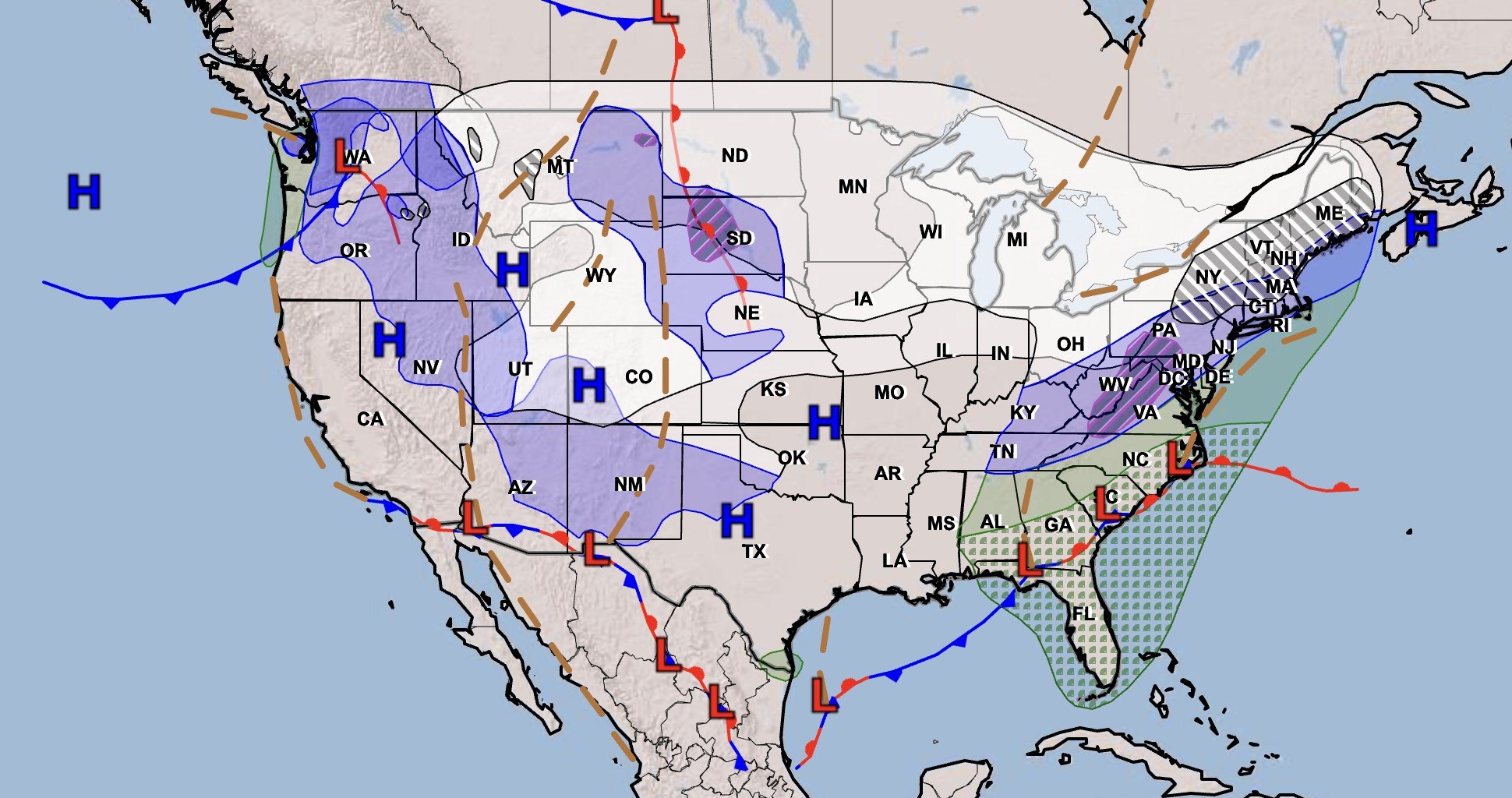
Just as the holiday travel rush fades, a powerful nor’easter is forming over the Gulf Coast and barreling toward the Northeast, bringing potentially dangerous conditions.
The storm is expected to surge up the Eastern Seaboard late Monday into Tuesday, unleashing heavy snow, freezing rain, and wind from Tennessee to Maine, according to forecasters at the National Oceanic and Atmospheric Administration. Interior parts of the Northeast could see more than a foot of snow, while the southern Appalachians brace for dangerous ice accumulations.
In October, a similar storm brought widespread power outages, with more than 4,000 customers losing power in Massachusetts alone from heavy rain and gusty winds. It’s a reminder that even as a quieter-than-average hurricane season comes to an end, homeowners still need to prepare for other extreme weather threats.
And the preparation for a winter nor’easter is different. Here’s what this storm will bring—and how homeowners can get ready now.
What the storm will bring—and where
A low-pressure system off the Gulf Coast is expected to strengthen rapidly on Monday night, as the nor’easter sweeps up the Eastern Seaboard into Tuesday.
Snowfall will begin arriving as soon as Monday night, with the heaviest accumulation forecast from the Poconos through the Catskills, Berkshires, and into Maine. These interior areas could see 5 to 10 inches, with some localized totals in higher-elevation areas seeing over a foot of snow by Tuesday night.

To the south, a corridor of freezing rain is expected to develop on Monday in parts of Oklahoma and Arkansas, then expand into the central and southern Appalachians by Monday night. Areas from Southwestern North Carolina through Western Virginia and into Western Maryland could see up to a quarter-inch of ice, creating treacherous road conditions and an increased risk of power outages.
In New York City and coastal areas, rain is expected to arrive on Tuesday morning, with little to no snow accumulation. Light snow and rain may also begin early Monday in parts of New England and upstate New York, before transitioning to heavier precipitation later in the day.
The worst of the storm is expected to taper off by Tuesday night, though parts of West Virginia, Virginia, and North Carolina could see the greatest icing potential through Wednesday night.
Most homeowners aren’t prepared for extreme weather, data shows
Basic preparedness for major storms and resulting disruptions is alarmingly low across the U.S., according to a national survey by SafeHome.org. Only 19% of homes have backup power sources, and only 5% of Americans have a fully stocked emergency supply kit.
What’s more troubling, though, is that nearly half of Americans now rely on social media for storm preparation guidance rather than expert sources. And nearly 1 in 3 didn’t take any emergency preparedness steps at all in the past year.
Those gaps are colliding with a clear rise in costly winter weather. Winter storms and freezes caused $3.6 billion in damages in 2024 and more than $27 billion in 2021, according to NOAA.
For homeowners, that’s a stark warning. Nor’easters and similar winter storms can threaten their biggest asset through burst pipes, prolonged power outages, and damage from snow and ice. With this week’s storm on the way, it’s critical to take steps to prepare now.
Protect plumbing before the freeze hits
When a nor’easter barrels in, the obvious threats are outside: snowdrifts, black ice, downed power lines. But inside your home, frozen pipes could be the costliest consequence of all.
“Sometimes during a freeze event, you may not know a line has frozen and ruptured until after the weather relents and a thaw begins,” explains Russell Vent, vice president of Paul Davis Restoration, a 24/7 water and fire damage restoration service. “This can be a major surprise to those who believe everything is fine during a freeze event, just to uncover a burst pipe causing major damage after the weather warms back up.”
As temperatures plunge across the Northeast in the wake of the storm, unprotected plumbing systems can quickly become ground zero for severe water damage. But the real danger is that you may not see the problem until the thaw.
“Overall, the best thing for you to do in preparing for a freeze is to think plumbing,” Vent adds. “Pipe bursts from a freeze can be some of the most catastrophic events that can happen to a property. If you can avoid plumbing lines from freezing, you eliminate much of the potential damage.”
Vent urges homeowners to take time now to trace where their pipes run, especially those along exterior walls or in drafty areas like basements, attics, and crawl spaces. Check for proper insulation, and make sure outdoor spigots have been shut off and fully drained.
And if you’re planning to be away during the storm, extra precautions may be worth the peace of mind.
“If you are leaving due to weather or you will be away, it may even be a good idea to have your home temporarily winterized by a professional,” Vent says.
Don’t wait until the ice thaws and water starts seeping through the ceiling. Plumbing failures after a hard freeze can be devastating and are often preventable.
Prevent ice dams during and after the storm
As heavy snow blankets rooftops and deep cold settles in behind the storm, conditions will be ripe for ice damming—one of winter’s most hidden and destructive threats to homes.
“Ice damming is the buildup of ice on the eaves of pitched roofs from a heated structure,” explains Vent.
When warm air escapes into the attic, it can melt the underside of the snowpack. The meltwater then refreezes along the colder edges of the roof, creating a wall of ice that blocks future runoff and forces the water back under shingles, into attics, and down walls.
To prevent this, Vent advises homeowners to take immediate steps.
“Ensure your roof is in good condition,” he says, and recommends ensuring your attic space is well insulated and your gutters are clear and operating before the snow starts to fall.
Vent also emphasizes the importance of proper airflow in attic spaces.
“Air should be making its way into the eaves (soffits) of the attic space and be exiting through roof vents or a continuous ridge vent,” he says.
If additional protection is needed, Vent recommends installing heat cables to reduce buildup, using a roof rake to clear the eaves, and applying ice melt socks to create runoff channels.
And if all else fails, have a professional on speed dial.
“Find out who in your local area provides ice dam removal and keep their number handy,” he says.
Is damage from winter storms covered by insurance?
When snow and ice wreak havoc on a home, most owners expect their insurance to step in. But that’s not always how it works.
“You will want to understand your insurance policy and what is and is not covered by your insurer,” says Vent. “Do not enter a freeze event assuming that every type of damage will be covered.”
Coverage can vary widely depending on the type of damage, the circumstances, and whether the homeowner took reasonable steps to protect the property in advance. For example, if a frozen pipe bursts and floods the home, your claim could be denied if the insurer determines you didn’t maintain heat or monitor the house properly.
“Make sure you are keeping your home heated properly and you can prove it,” Vent explains. “Some insurance companies will require proof from your energy supplier that your home was being heated properly before affording coverage of a claim.”
Vent adds that even if you’re not staying in the home full time, you need to keep an eye on it.
“Make sure you are checking on the property regularly,” he says. “Failure to monitor your property, in my experience, has also led to insurance claim denials.”
Fewer than 40% of households have recently reassessed their home insurance coverage, according to SafeHome.org’s survey. If you fall into this bucket, don’t wait until after the storm to ask questions about your policy. A quick call to your insurance agent could save you thousands.