
Miami Real Estate Market 2026: Fully Researched Outlook for Buyers, Sellers, and Investors
The Miami market has entered 2026 with mixed but actionable signals. On one hand, financing conditions have improved from the peak-rate environment of 2024 and 2025. On the other hand, not every property segment is behaving the same way. Detached homes, luxury product, and selected lifestyle submarkets can still feel competitive, while parts of the condo and townhome segment are seeing softer pricing and higher inventory. For buyers, sellers, and investors, this is the type of market where strategy matters more than headlines.
This guide is built from current data points available as of March 2026, including Freddie Mac weekly mortgage readings, Redfin’s Miami market snapshot, FRED time series for mortgage rates, Miami HPI and inflation context, and Miami Realtors market intelligence. The objective is practical decision-making: how to read the numbers, where leverage sits right now, and what to do over the next 3-12 months.
Table of Contents
- 1. The Core Market Signal in 2026
- 2. Mortgage Rates and Payment Power
- 3. Price Behavior: Short-Term Softness vs Long-Term Uptrend
- 4. Condos vs Single-Family: Why Segmentation Is Everything
- 5. Brickell and Downtown Miami: What to Watch
- 6. Buyer Strategy for 2026
- 7. Seller Strategy for 2026
- 8. Investor Strategy and Underwriting Guardrails
- 9. Key Risk Scenarios and How to Hedge Them
- 10. 12-Month Miami Market Outlook
- 11. Action Checklists
- 12. FAQ
- 13. Sources
1. The Core Market Signal in 2026
The clearest takeaway today is that Miami is not a single market. You are looking at multiple submarkets and product types moving at different speeds. Recent headline data shows Miami median sale price around $615,000 in January 2026, with a year-over-year decline of about 6.4% (Redfin). That is important, but incomplete on its own. It tells you current transaction pricing has cooled from prior levels, but it does not erase the broader long-term appreciation cycle that Miami experienced over the last five years.
Long-run data supports this point. The Miami-Miami Beach-Kendall all-transactions HPI series on FRED (ATNHPIUS33124Q) moved from approximately 377.71 in 2021 Q1 to 657.50 in 2025 Q4. Even with periodic pullbacks, the structural trend remains materially above pre-boom levels. For practical decision making, this means buyers should negotiate hard on current soft spots, while sellers should avoid panic pricing and instead focus on segment-level evidence.
In short: Miami in 2026 is less about direction and more about dispersion. Good assets in good locations are still attracting interest. Overpriced or poorly positioned inventory is being discounted faster than in prior years.
2. Mortgage Rates and Payment Power
Financing is the first variable that changes behavior in high-price metros, and Miami is no exception. Freddie Mac’s Primary Mortgage Market Survey shows the 30-year fixed rate at 5.98% for the week ending February 26, 2026, down from 6.85% one year earlier. That spread is meaningful. A near-0.9 percentage-point shift can substantially improve payment affordability and qualification outcomes for rate-sensitive buyers.
Still, lower does not mean cheap. Near-6% financing in a high-tax, high-insurance environment can still produce elevated monthly housing costs, especially for leveraged buyers. This is where many consumers misread the market: they focus on rate direction but underestimate total carrying cost (principal, interest, taxes, insurance, HOA/condo dues, reserves, and maintenance).
For buyer strategy, the right move is to underwrite multiple payment scenarios:
- Base case at current market rate
- Stress case if rates move +50 bps before lock
- Opportunity case if rates drift lower and refinancing becomes viable in 12-24 months
For sellers, lower rates create a larger buyer pool, but not an unlimited one. Properties that require high HOA, major deferred maintenance, or uncertain special assessment exposure can still face buyer resistance despite improved borrowing rates.
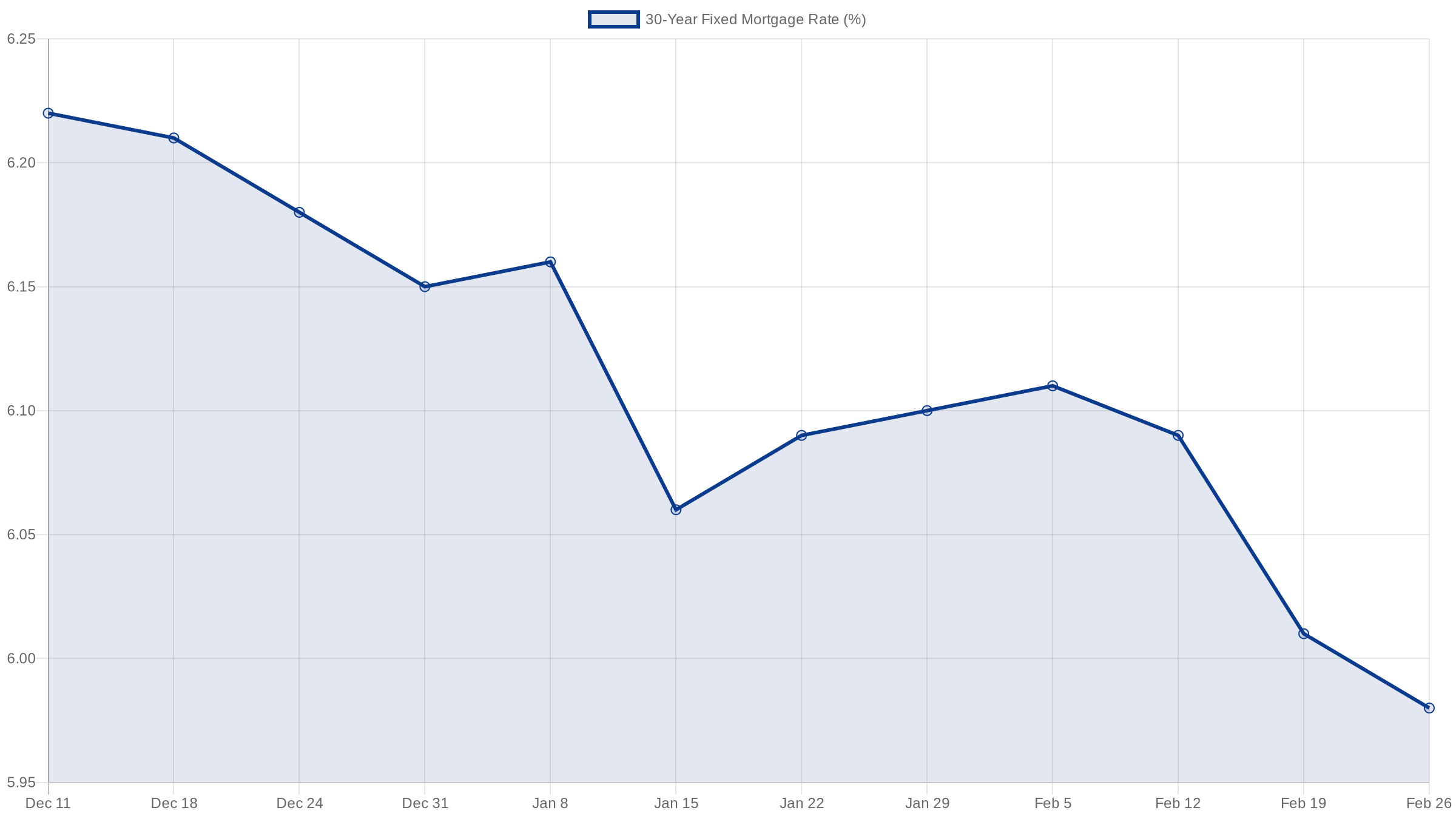
Figure: Recent mortgage rate trend (Freddie Mac / FRED source series MORTGAGE30US).
3. Price Behavior: Short-Term Softness vs Long-Term Uptrend
Many market participants struggle to hold two truths at once: short-term corrections can occur inside long-term uptrends. Miami currently reflects exactly that dynamic. The January 2026 median sale-price pullback on Redfin highlights near-term pressure in portions of the market. But long-horizon price index data still reflects significant appreciation compared with early 2021 levels.
What explains this? Primarily, base effects and recalibration. When markets move sharply upward in a compressed timeframe, a later normalization period can look dramatic in year-over-year terms, even if absolute levels remain historically elevated. This is especially visible in segments where inventory rose faster (typically condo/townhome categories).
Another important lens is inflation and real returns. FRED’s Miami CPI series (CUURA320SA0) reached 359.125 in December 2025, indicating costs in the region remain elevated. Even when nominal home prices cool in select areas, replacement costs, construction inputs, and household operating expenses can remain high. For owners and investors, that matters for long-run pricing floors.
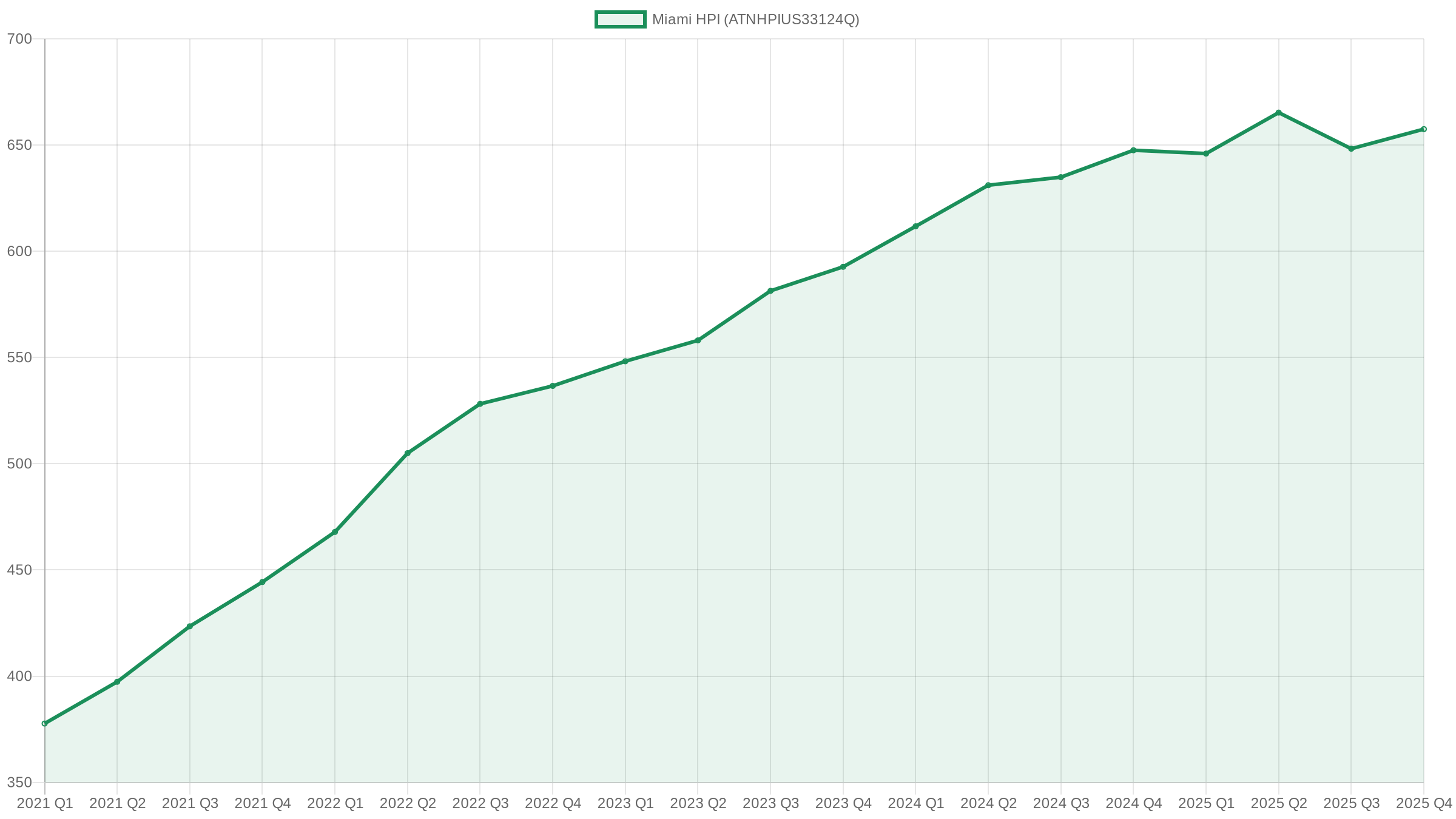
Figure: Long-run Miami HPI trend (FRED ATNHPIUS33124Q).
4. Condos vs Single-Family: Why Segmentation Is Everything
Segmentation is the single most important framework in Miami right now. Public market intelligence from Miami Realtors (October 2025 reporting) showed condo/townhome inventory around 14 months, with condo median sale price down roughly 3.6% year-over-year. That is a very different condition than supply-constrained detached housing pockets.
In practical terms, this creates asymmetrical leverage:
- Condo/townhome buyers: Usually stronger negotiation position, broader choice set, better chance for concessions or price improvement.
- Single-family buyers: Still need fast, clean execution in high-demand micro-locations.
- Condo sellers: Must win on both pricing and presentation from day one; stale listings are penalized quickly.
- Single-family sellers: More room to defend value if property quality and location are strong.
For investors, the condo segment now requires extra diligence beyond cap-rate snapshots. Building-level governance, reserve studies, age of major systems, insurance trajectory, and pending assessments can dominate returns more than gross rent growth assumptions.
5. Brickell and Downtown Miami: What to Watch
Brickell and Downtown remain high-visibility, high-liquidity submarkets, but they are also more sensitive to supply waves, investor sentiment, and financing changes than many suburban single-family areas. In 2026, the right way to analyze these locations is by project quality and unit-level competitiveness, not broad ZIP-level averages.
Core items to evaluate in Brickell/Downtown deals:
- Comp set by exact building and line, not district average
- Inventory depth for similar units in the same tower
- HOA trend and reserve adequacy
- Owner-occupant versus investor share in building
- Expected rent volatility under different employment and migration assumptions
When inventory is elevated, unit differentiation matters more: floor height, view corridor, parking count, and renovation quality can drive meaningful spread in days-on-market and final sale-to-list ratio.
6. Buyer Strategy for 2026
Buyers who do well in this market combine patience with execution speed. The process should be systematic:
- Define use-case first: primary residence, part-time occupancy, long-term rental, or short-term strategy (if legal/building-allowed).
- Set payment guardrails: stress-test taxes, insurance, and association fees, not just mortgage principal/interest.
- Underwrite opportunity cost: compare waiting 6-12 months versus buying now and refinancing later if rates continue easing.
- Negotiate with evidence: present recent comps, inventory months, and unit-specific alternatives.
- Prioritize due diligence windows: inspection, condo docs, reserve disclosures, and insurance confirmations.
In practical negotiation, ask for one of three paths: purchase price reduction, seller-paid closing costs, or targeted repair/credit package. In condo-heavy segments, structured concession strategy can outperform pure price bargaining.
7. Seller Strategy for 2026
Sellers should treat 2026 as a precision market. The old “test high, reduce later” strategy frequently underperforms because digital buyers penalize stale listings quickly. Your first two weeks on market are your highest-leverage window.
Best-practice seller playbook:
- Launch at data-supported pricing (not aspirational pricing)
- Use pro media and transparent disclosures
- Pre-address objection points (insurance, assessments, major systems)
- Offer showing flexibility in first 10-14 days
- Track inquiry-to-showing-to-offer conversion weekly and adjust fast
Condo sellers in higher-inventory pockets should emphasize total ownership clarity. Buyer hesitation often comes from uncertainty rather than just price. A clean, organized disclosure package can reduce friction and protect net proceeds.
8. Investor Strategy and Underwriting Guardrails
For investors, 2026 in Miami is less about headline appreciation bets and more about disciplined underwriting. The market still offers opportunity, but weak assumptions are being punished.
Five guardrails for current investor acquisitions:
- Model conservative rent growth: do not rely on peak-cycle rent trajectory.
- Use realistic vacancy and turnover assumptions: especially in high-competition towers.
- Include insurance and HOA escalation scenarios: this can materially alter net yield.
- Stress refinance terms: cap rate compression is not guaranteed.
- Prefer liquidity over theoretical upside: buildings with deeper buyer/renter pools often outperform in risk-adjusted terms.
When comparing assets, evaluate three exit paths up front: owner-occupant resale, investor resale, and hold-for-cashflow. If only one exit path works, the deal carries higher risk in a bifurcated market.
9. Key Risk Scenarios and How to Hedge Them
Scenario A: Rates stall near current levels. Strategy: buy only when monthly payment stays resilient under conservative stress assumptions.
Scenario B: Rates fall further, demand returns quickly. Strategy: secure high-quality assets before competition resets; avoid overpaying for low-quality inventory.
Scenario C: Condo costs rise faster than expected. Strategy: prioritize reserve strength, building governance, and fee trajectory transparency.
Scenario D: Local demand softens in specific submarkets. Strategy: focus on superior location attributes, transit walkability, and enduring unit desirability.
Across scenarios, the hedge is the same: quality underwriting, clear downside planning, and flexibility in financing structure.
10. 12-Month Miami Market Outlook
Base case for the next 12 months: Miami remains a mixed, opportunity-rich market with segment-level volatility. Financing improvement should support transactional activity versus 2024 highs in borrowing costs, but inventory and carrying-cost pressure in some condo segments may cap aggressive price rebounds.
Most likely outcomes by segment:
- Prime single-family pockets: moderate resilience, selective competition.
- Condo/townhome segments with high supply: continued negotiation leverage for buyers, uneven pricing.
- Prime urban towers with strong fundamentals: better relative performance than undifferentiated inventory.
Investors and owner-occupants who move with disciplined assumptions, rather than broad-market emotion, should be best positioned in this phase.
11. Action Checklists
Buyer Checklist
- Lock target payment range and stress-test at +0.50% rate.
- Review building reserves and assessment exposure before offer.
- Negotiate with data: comps, inventory depth, and days-on-market.
- Preserve optionality: refinance path, resale path, rental path.
Seller Checklist
- Price to current comp reality, not last-cycle memory.
- Maximize first 14 days with premium media and access.
- Prepare all ownership-cost disclosures up front.
- Track response metrics weekly and adjust quickly.
Investor Checklist
- Underwrite NOI with conservative rents and higher expenses.
- Model refinancing and exit under non-ideal conditions.
- Prioritize building-level quality and governance.
- Avoid dependence on single-point appreciation assumptions.
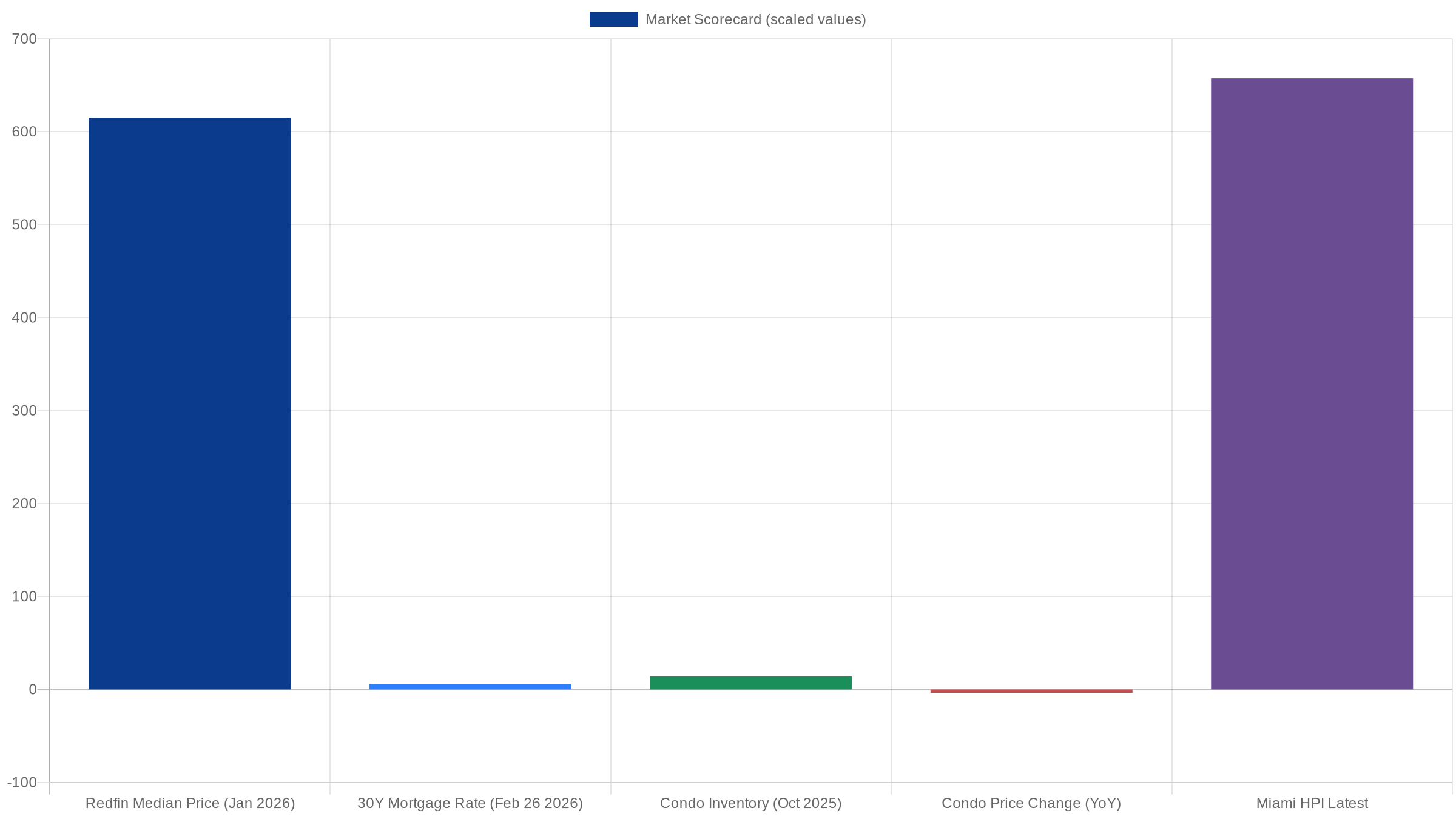
Figure: Miami market scorecard (compiled from cited sources; metrics shown in different units).
12. FAQ
Is Miami a buyer’s market in 2026?
It depends on segment. Condo/townhome inventory conditions suggest more buyer leverage in many areas, while selected single-family pockets remain tighter.
Are mortgage rates helping affordability in Miami?
Yes, lower rates versus one year ago improve payment math at the margin, but total ownership costs remain important in Miami.
Should buyers wait for further price declines?
Waiting can work in high-supply segments, but timing is uncertain. Strong deals are usually found through disciplined underwriting rather than market-timing guesses.
What is the biggest mistake condo buyers make right now?
Underestimating building-level risk factors such as reserve adequacy, insurance trajectory, and assessment exposure.
How should sellers adjust in today’s market?
Start with realistic pricing, stronger presentation, and transparent disclosures. Overpricing tends to reduce final net outcomes.
Is Brickell still attractive for investors?
It can be, but selectivity is critical. Tower quality, fee structure, and comparable inventory determine outcomes more than neighborhood branding alone.
What indicators should I monitor monthly?
Mortgage rates, closed-price trend, active inventory, days-on-market, and building-level fee/assessment changes if you are condo-focused.
What is the best 2026 strategy for most participants?
Be data-driven, not narrative-driven. Miami is presenting opportunities, but execution discipline is what separates good outcomes from poor ones.
13. Sources
- https://www.freddiemac.com/pmms
- https://fred.stlouisfed.org/series/MORTGAGE30US
- https://fred.stlouisfed.org/series/ATNHPIUS33124Q
- https://fred.stlouisfed.org/series/CUURA320SA0
- https://www.miamirealtors.com/market-intelligence/