
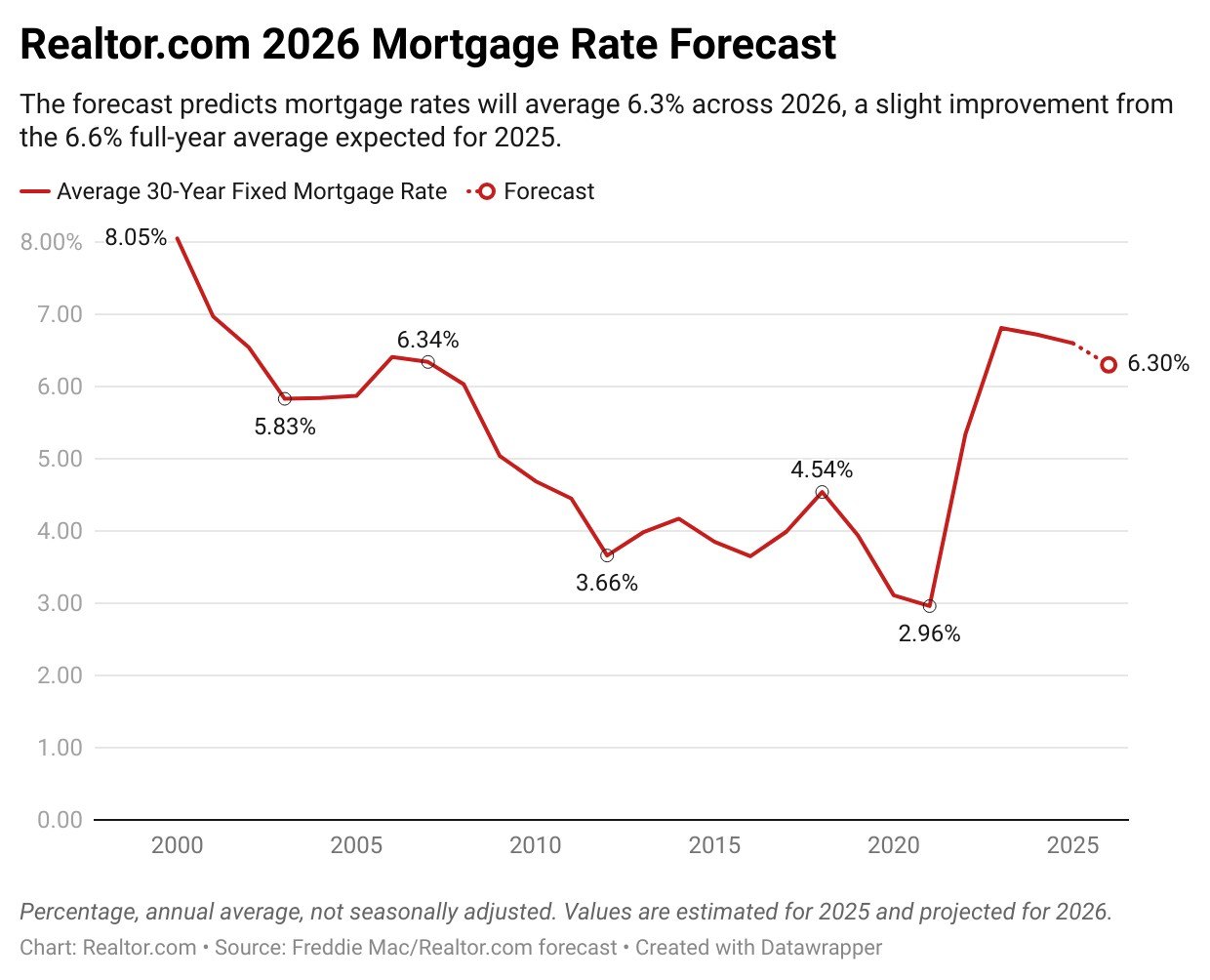
Mortgage rates will continue to average above 6% next year, but affordability will improve modestly as the typical monthly payment falls below 30% of a household’s income for the first time since 2022, the Realtor.com® economic research team predicts in its 2026 housing forecast.
The forecast predicts mortgage rates will average 6.3% across 2026, a slight improvement from the 6.6% full-year average expected for 2025, but still well above the 4% historic average recorded from 2013 to 2019.
Nationally, home prices will continue to grow 2.2% through the end of next year, after rising by 2% in 2025, the forecast indicates. However, incomes and overall inflation are expected to continue rising faster than growth in home prices, delivering a slight boost to affordability.
“After a challenging period for buyers, sellers, and renters, 2026 should offer a welcome, if modest, step toward a healthier housing market,” says Realtor.com Chief Economist Danielle Hale. “Incomes climbing faster than inflation as mortgage rates steady at a lower level create space for affordability to improve.”
Still, home sales are projected to remain sluggish. After existing-home sales hit a 30-year low in 2024, the forecast estimates they will improve slightly through the end of 2025, rising 0.1% to 4.07 million.
Next year will see further modest improvement, with total existing-home sales rising 1.7% to 4.13 million as affordability improves. While that would be an improvement on the past three years, it’s still well below the 5.28 million annual average seen from 2013 to 2019.
Meanwhile, the forecast expects rents to decline slightly by 1% next year, while new-home construction expands 3.1% and existing-home inventory continues to grow by 8.9%.
Forecast for homebuyers in 2026
Homebuyers will benefit from easing mortgage rates as well as a modest decline in real, or inflation-adjusted, home prices, according to the forecast.
The Realtor.com economic research team expects household income to grow more than 3.6%, beating both home prices and overall inflation, which it expects to rise back above 3%.
And as a result of easing mortgage rates, the typical monthly payment to buy the median-priced home sold is expected to fall 1.3% year over year, marking the first decline in monthly payments on average across the year since 2020.
The monthly payment to buy the typical home is expected to slip to 29.3% of median income, its first year below the 30% affordability threshold since 2022 when mortgage rates shot higher.


The forecast expects unemployment, which was at 4.3% in August, to climb further, but not exceed 5% in 2026.
“In aggregate, consumers look to be in good shape, but lower-income and younger individuals may be more vulnerable as the labor market cools,” the report states.
Homebuyers will also benefit from continued expansion of inventory, with the supply of existing homes for sale expected to grow 8.9% in 2026, marking a third consecutive year of gains.
Still, the pace of inventory expansion has slowed, as the market edges closer to pre-pandemic norms. By the end of 2026, nationwide inventory levels are expected to remain roughly 12% below pre-2020 averages, an improvement from a 19% gap in 2025 and nearly 30% in 2024.
New construction will also continue to play an important role in providing more options to homebuyers, with single-family housing starts projected to rise 3.1% from 2025 to 1 million.
Overall, the national housing market is expected to remain in balanced territory in 2026, with an average 4.6 months of supply across the year.
“The path back toward historic levels of affordability will be gradual, but 2026 takes a solid step in the right direction,” says Hale. “For many buyers who have spent years navigating limited options and steep competition, a balanced market with more choices and slightly lower cost burdens can be a game changer, even if conditions remain far from easy.”
Forecast for home sellers in 2026
Over the past few years, sellers have faced a market of sluggish sales and rising inventory, tilting the balance of power slowly in favor of buyers.
Those trends are likely to continue in 2026, according to the new forecast, suggesting that sellers should remain flexible and set realistic expectations when it comes time to list their home.
“Sellers who definitely want to sell will want to pay attention to the competition when setting a price, and they may need to be prepared to adjust expectations based on market feedback,” the report states. “The degree of adjustment will depend on their geography and also their price point.”

Recently, the market has remained stronger in the Northeast and Midwest compared with the South and West, and the new forecast suggests that those trends will continue in 2026.
Recent data also shows that price cuts are somewhat more common among lower-priced homes, and comparatively rarer among homes priced above $1 million, where wealthy buyers are still driving solid sales activity.
The forecast indicates that home prices will rise modestly in many markets next year, but prices may decline in some markets, particularly in the South and West.
Forecast for renters in 2026
In 2026, rental supply is expected to continue outpacing demand, driving down rents and boosting renter mobility.
Rental affordability is expected to continue improving in 2026 after asking rents declined an estimated 1.6% in 2025. Next year, the forecast expects rents to fall an additional 1% annually, as more new multifamily units hit the market.
“Declining rental prices will continue to give renters more relief from [COVID-19] pandemic highs. It’s not a dramatic reset, but it’s a meaningful shift that moves the market back toward balance,” says Hale.
This should continue to make renting a relatively cost-effective option compared with buying in the short term across most markets.
Young adult renters, who lack access to historically high home equity to purchase a home, could take advantage of this trend by shopping around when their lease expires and seeing if there are more affordable rental units in their market.